
How to build a new home in London: A step by step guide
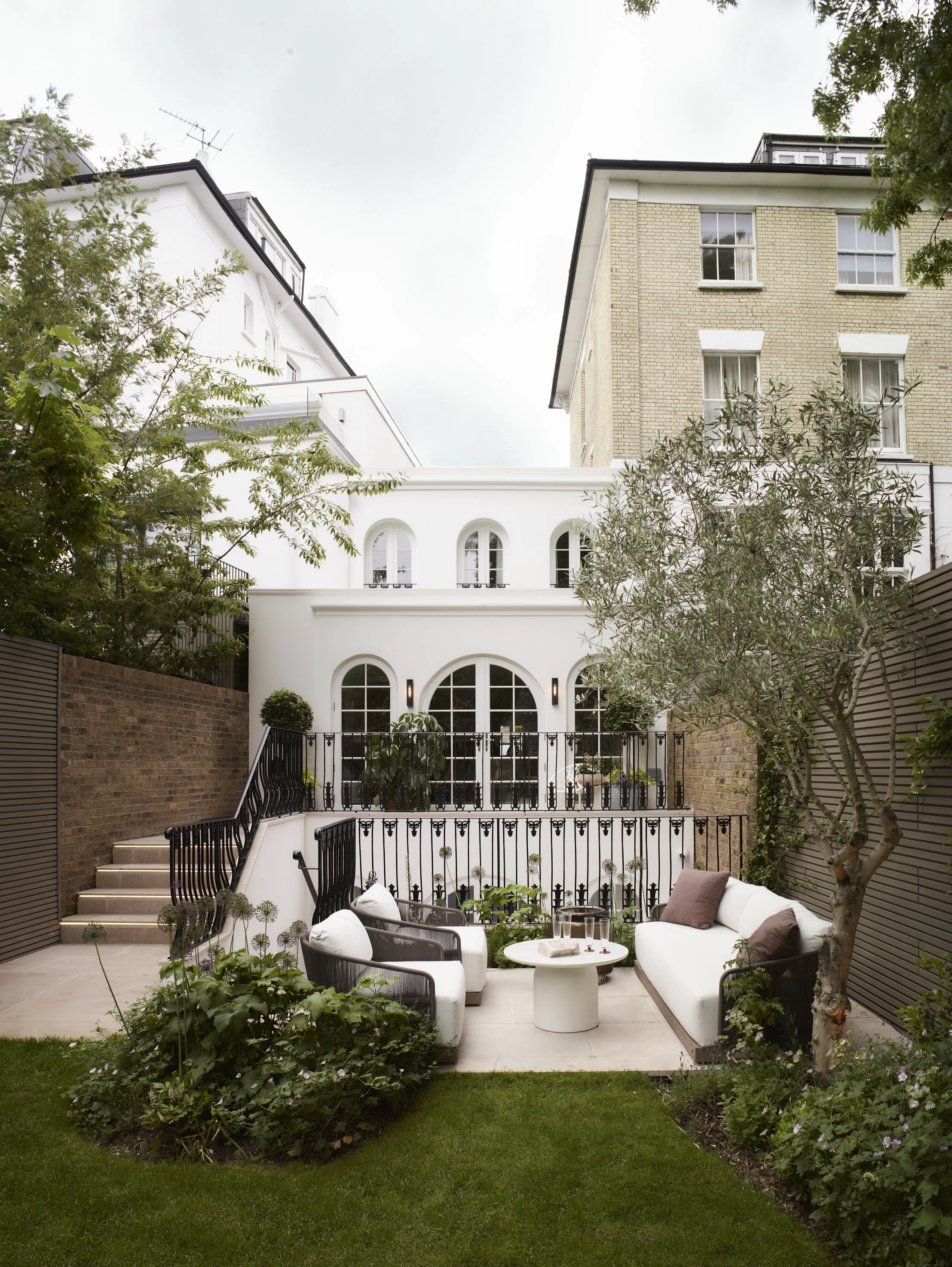
At the end of the process of building a new home in London, you can have a house that is uniquely yours, reflecting your taste, personality and one which fits perfectly into its surroundings.
The allure of a fresh start
Imagine finding the perfect location for your new home in London. A beautiful street, close to excellent schools, well connected, somewhere you can genuinely see your family settling long term. But the house on the plot doesn’t work for you. You love good design and the house doesn’t match your dream of a beautiful home, It might be the ugly house on the road, it may be outdated, awkwardly arranged, or simply doesn’t reflect the way you want to live.
At this point, most people assume they have to compromise. But increasingly, a different question emerges:
Can we replace the existing house’s design and build something new that reflects our taste and how we want to live?
In London, with its heavily regulated planning system, this requires careful handling. If the property sits within a conservation area, demolition is often restricted and must be very carefully justified. In other cases, a house can be replaced or substantially rebuilt, but only where the proposal is well considered and responds properly to its surroundings.
Where it is possible, building a new home offers something fundamentally different. It allows the house to be designed from first principles. The proportions, the flow of spaces, the relationship to light and garden, all considered together rather than adjusted retrospectively. If the process is carefully mapped out then this can be a really rewarding and positive process.
However, if as a family you are juggling a demanding career and running a busy household, you will just not have the time to manage a project of this scale on your own.
There are two key aspects to getting this right, the first is developing a beautiful new design but the second is a clear, structured process that will allow the project to be delivered, the sooner the process is engaged with the quicker and simpler it will be to reach your goal.
For those considering buying a house to knock down or substantially rebuild in London, there are a series of steps to follow and how those steps are managed will affect how the experience feels along the way.
Having a trusted advisor from the outset can simplify and streamline this process, that could be a client’s agent, a buying agent or an architect. Involving an architect will allow you to look at sites and understand their potential quickly, seeing the long term outcome possible.
For this article, we refer to the RIBA Stages of work, a helpful sequence for building projects. by the Royal Institute of British Architects.
Step 1: Define your budget and choose the right location
(RIBA Stage 0 – Strategic Definition)
This is the point where most people begin, often before they have spoken to an architect.
There is usually a strong sense of where they want to live, driven by schools, proximity to work, and an established way of life. Alongside this sits a broad understanding of what they are prepared to invest, even if the detail is not yet fully defined.
At this stage, the experience is often one of testing assumptions.
Is this the right area long term?
Is it realistic to build something new here?
Is the house in a conservation area? Conservation areas make it much harder to justify a complete knock down and rebuild, so usually easiest to find somewhere at least just outside of a conservation area.
What level of investment will be required to do it properly? It’s worth speaking to an Architect or Quantity Surveyor who will be able to give you a ballpark figure of how much a new property will cost to build. You’ll also need to work out approximate professional costs, so that you have a full figure to work to before making your purchase.
The decisions made here shape everything that follows. Clarity at this stage removes a great deal of uncertainty later.
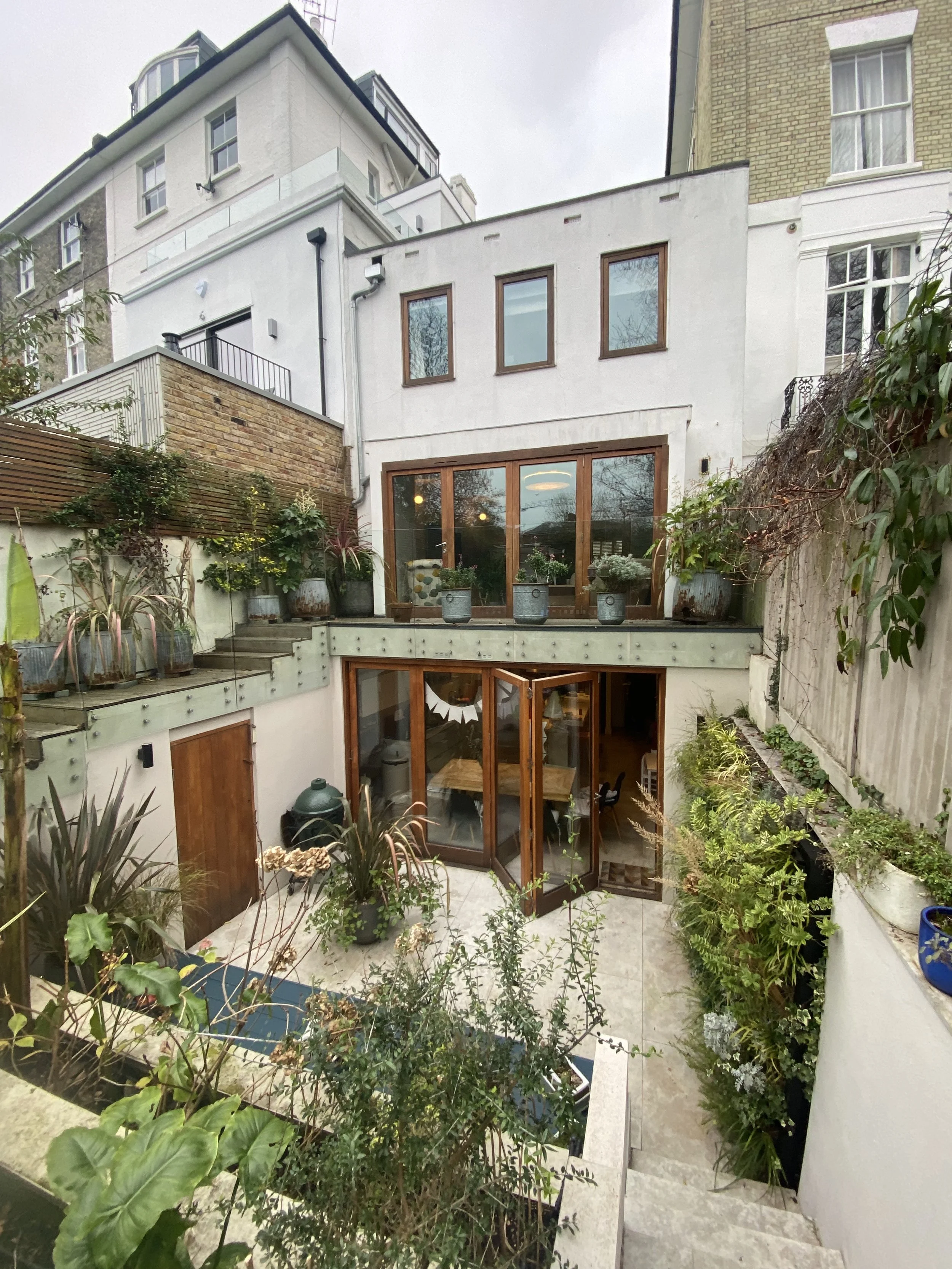
Finding a home that does not look like your dream home at first can actually be a wonderful opportunity - The original house at Belsize Park presented the perfect opportunity to create something new as its appearance was so out of keeping with the surrounding area.
Step 2: Find the right plot to rebuild
(RIBA Stage 0 – Strategic Definition)
At the last stage you will have defined your budget for purchasing a property, you’ll know roughly how big you need your future home to be and you’ll be looking out for key things like, whether it is in a conservation area, whether neighbouring properties or properties nearby have been given permission to rebuild or significantly alter their houses. This stage involves a shift in how you look for and view properties
Instead of looking for a finished home, you begin to look for potential. A house that does not quite work, but sits on a site that could be transformed.
This can feel uncertain at first. The value is not always obvious, and the risks are not always clear.
What helps is having a framework for assessing:
Which council does the house or plot sit within, what are their policies for new homes?
How likely are you to get planning permission for the type of house you wish to build
What are the neighbouring houses like? Would you be happy to match to those?
Will you be allowed to add an extra storey above?
Would you be able to add a basement?
Will the plot of the house make it easy to do building works? How can materials and machinery be brought into the house and rubbish taken away.
The house you look at may be ugly and not to your taste but if you understand the constraints and opportunities that a house has you can start to look deeper and often find something that give you the perfect chance to create your own new home.
This moment is key. The existing house is not the attraction.
The opportunity lies in what it can become.
This is often the point where early guidance brings a sense of confidence and direction.
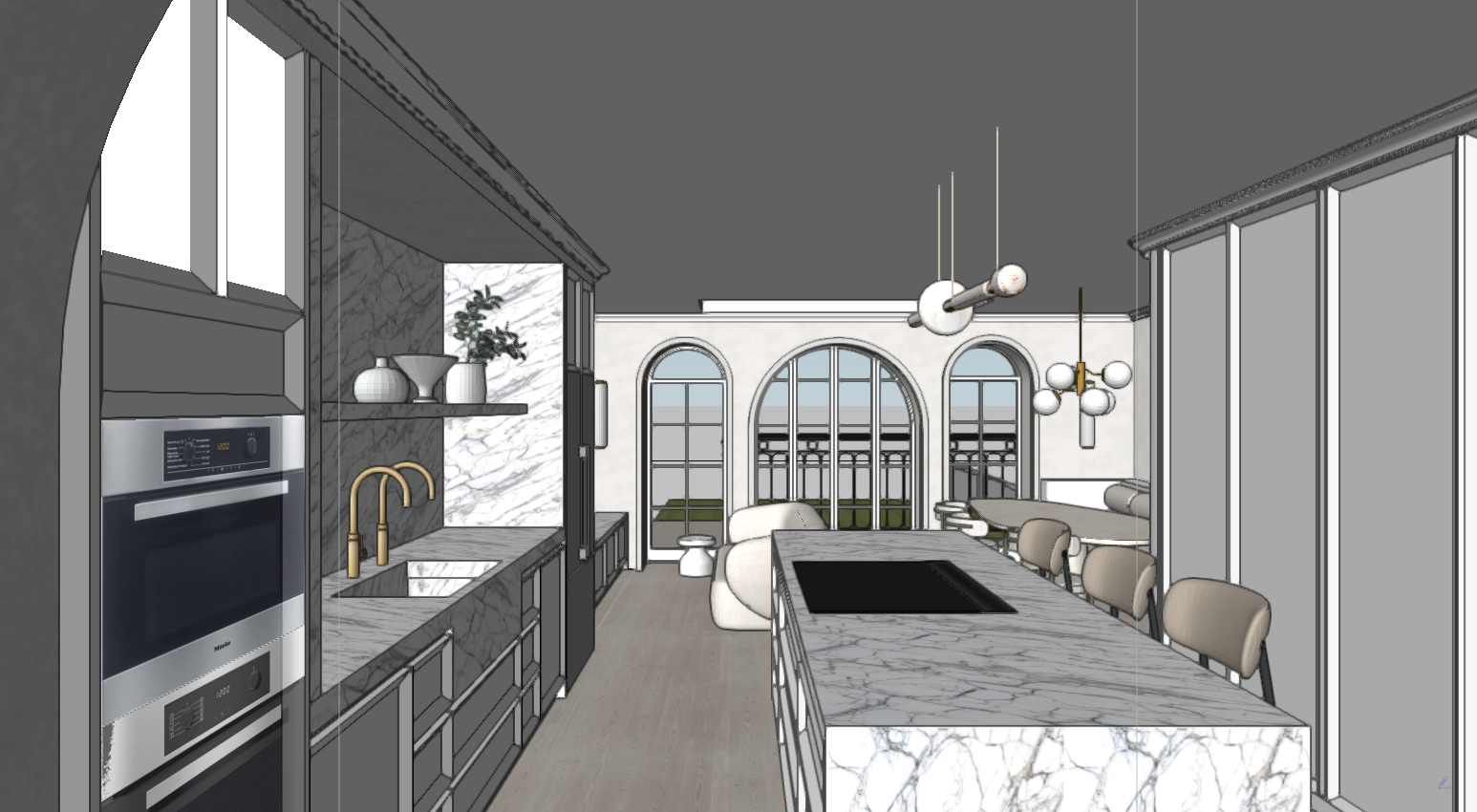
Design models work through the look, feel and design detail of the project’s design.
Step 3: Develop the design with your architect
(RIBA Stage 1 – Preparation and Briefing & RIBA Stage 2 – Concept Design)
This is where the project begins to feel real. For many clients, it is also the most enjoyable part of the process. There is time to think, to explore, and to shape something that reflects how they want to live. The experience at this stage is collaborative, but also guided.
Focus on how you want to feel in your new home and let the practical aspects of the design flow from this
Conversations focus on how your daily life needs to work, rather than simply listing rooms that need to be included.
Early sketches and models test ideas and begin to give form to the house
There is often a moment during this stage where the project “clicks”. The house becomes clear, and the direction feels settled. That clarity is what allows everything that follows to proceed with confidence.

The design image used at the planning stage to convince the planners of the quality of the design and how the new house would fit into the existing context
Step 4: Secure planning permission for a replacement house
(RIBA Stage 3 – Spatial Coordination)
This is typically the stage that clients feel most uncertain about at the outset. Planning in London is complex, and where demolition or replacement is involved, it requires a careful and considered approach. The experience, when managed properly, is more structured than many expect.
The design is refined to align with planning policy and if the site is in a conservation area all aspects of the conservation area will need to be factored in.
It can be useful to do a pre app to gauge the application of local policy with the council at the current time if the scheme is likely to be slightly contentious.
The drawings and information submitted for the planning application needs to be carefully considered so that only relevant information is included so that the application has the very best possible chance of success. Including more information than is necessary tends to prompt unnecessary questions and comments and slows down the process.
Once you have planning permission you feel secure knowing that the project is ready to go and will definitely be a reality and you can get started on the most information heavy stage of the project where every aspect of the design is resolved.
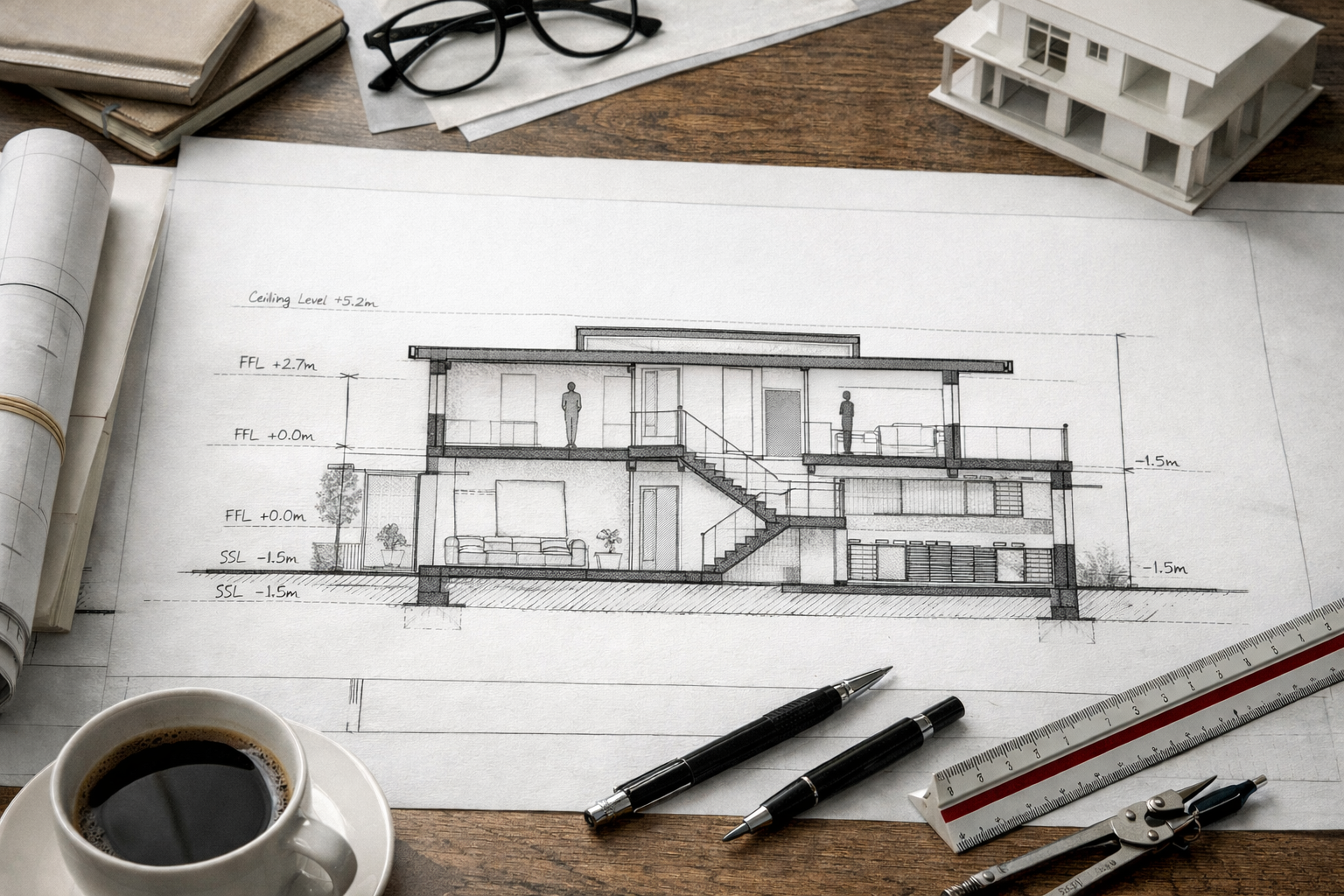
Technical drawings are produced that describe everything that needs to be built.
Step 5: Detailed design and technical development
(RIBA Stage 4 – Technical Design)
At this stage, the project becomes precise.
For clients, the experience shifts from broad ideas to detailed decisions. Materials are considered carefully, layouts are refined, and the house is resolved in full.
There is a sense of the project becoming tangible.
Details are worked through so that nothing is left unresolved
The wider team is coordinated
The information required to build the house is completed in full
When this stage is done well, it creates a strong sense of reassurance. The project feels fully thought through before construction begins.
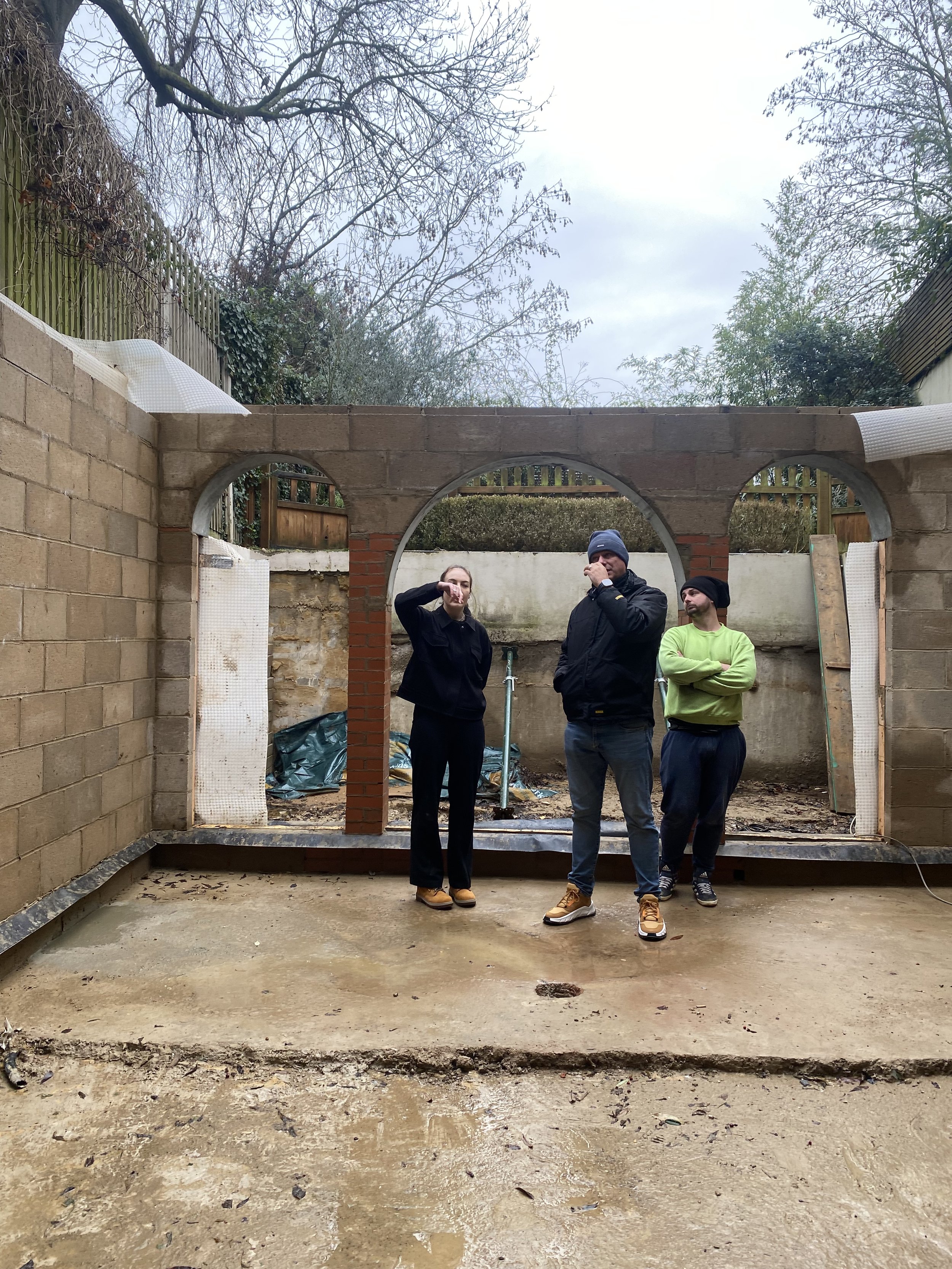
Construction stage at our Belsize Park house: The lower ground floor extension with new arched openings with bespoke steel beams. The team is standing what in what is now a beautiful living room.
Step 6: Construction – bringing your vision to life
(RIBA Stage 5 – Manufacturing and Construction)
The design is completed, the details are clear and now the project is ready to become a physical reality. It feels very rewarding as you start to see your home take shape bit by bit.
Construction is often a stage that is both eagerly anticipated but also can be worrying for clients embarking on a project for the first time. In reality, when the earlier stages have been properly managed, it becomes far more straightforward than expected. The clients role at this stage will not be manage the project, that will be taken care of by the Contractor’s team, the Contract Administrator, Architect and Project manager. Clients are kept informed of progress on site with weekly updates and site progress reports from site visits but unless there are changes made, will not need to make further decisions.
Progress is monitored regularly
Decisions are made at the right time
Quality is checked and maintained
Clients remain informed, but not burdened by the day to day complexity of the build.
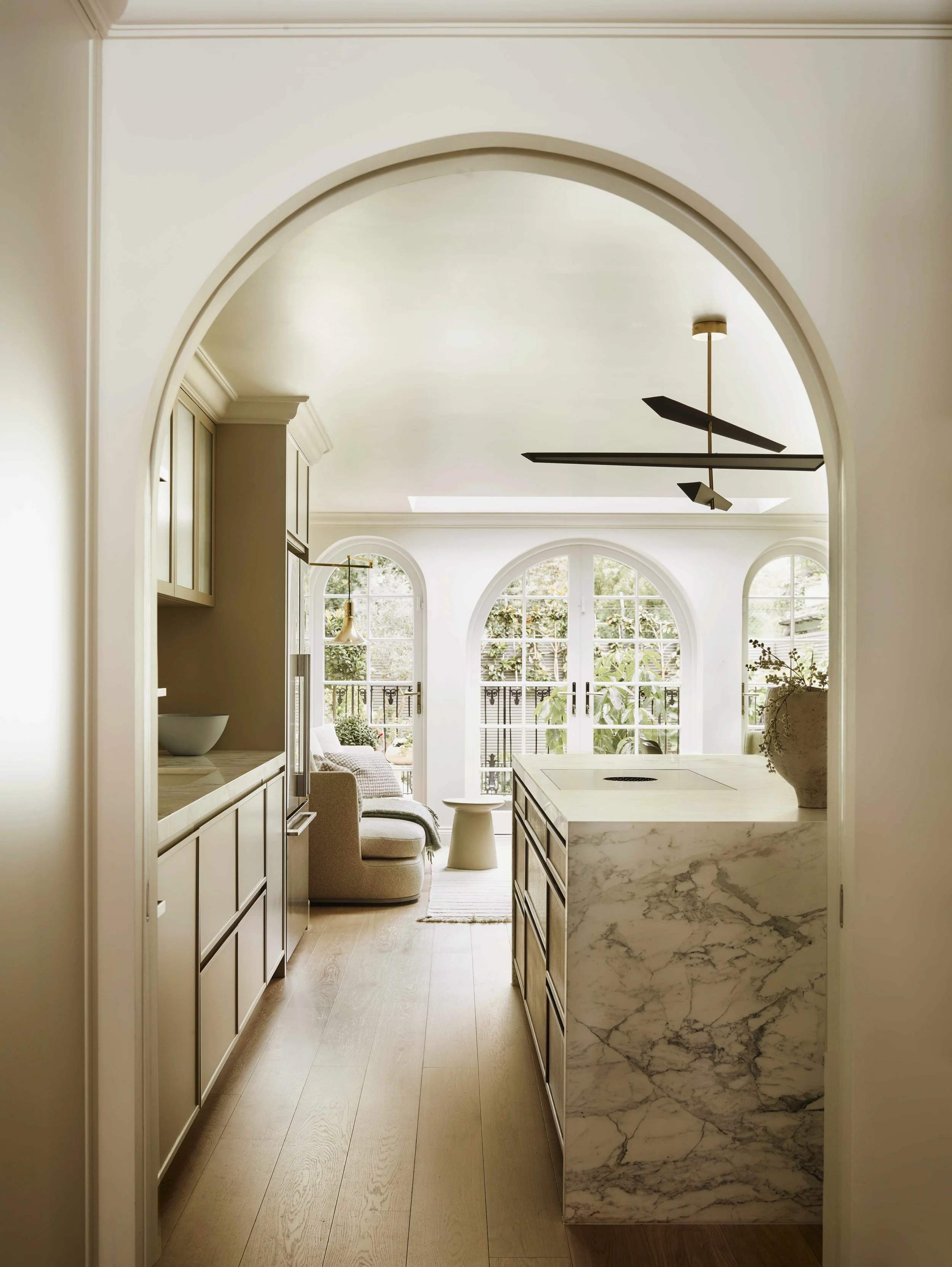
The finished house looking through the kitchen and open plan living area through to the beautiful back garden
Step 7: Handover and moving in
(RIBA Stage 6 – Handover & RIBA Stage 7 – Use)
As the project nears completion, attention turns to the final details. Every last detail is ‘snagged’ checked and made to be in keeping with the contract design details.
This is a transition point. The house stops being a building site and is now ready to be your home. The house feels considered, complete and uniquely your own.
Final inspections ensure everything is complete
Any outstanding items are resolved
A sparkle clean is undertaken throughout the whole house
Certification and approvals are in place
Retention money is held back from the contractor for up to one year to ensure any defects are fixed quickly.
This is also the point where the project is formally handed over to you, with all keys, manuals and documentation provided. You are able to walk through each space and begin to understand how the house will function day to day. Any final adjustments can be noted and addressed as you start to live in the space. The focus shifts from construction to occupation, with the house settling into its new life as your home.
Final thoughts: making your dream home a reality
Building a new home in London, particularly where an existing house is being replaced, is a complex process.
But for those approaching it with the right structure and the right support, it becomes far more measured and manageable than it first appears.
If you are considering buying a house to replace in London, the key is approaching it with a clear strategy from the outset. With the right team and a well-managed process, it becomes a far more straightforward and rewarding experience. We would be delighted to speak with you and provide some advice if you are thinking about building a new home in London, get in touch and we can book in a meeting.